The 60-Minute Wind Down Routine Before Bed
A minimalist 60-minute wind-down that survives your worst night — lower the light, lower your temperature, empty your head, then bed.

A wind down routine before bed only has three real jobs: lower the light, lower your body temperature, and empty your head. A workable version runs about 60 minutes — screens down and lamps only at the 60-minute mark, a warm shower at 45, tomorrow written down at 30, bed and dark by 15. Build it for the night you're wrecked, not the night you're motivated.
Most bedtime routines fail for the same reason most fitness plans fail: they're designed by the version of you with energy, for the version of you that has none left by 9pm.
You read a list somewhere. Fourteen items — journaling, stretching, a bath, gratitude, no screens after seven, meditation. On a good Sunday you manage about half of it and feel great. Then Wednesday happens. You get home late, slightly annoyed, wanting twenty minutes where nobody needs anything from you. The routine doesn't survive contact with Wednesday, and by week two it's quietly gone.
So here's a smaller, sturdier starting point.
What should a wind down routine before bed actually include?
Strip away the decoration and three things are actually doing the work:
- Lower the light. Light is the main signal your body clock uses to work out what time it is, and evening light exposure holds back melatonin, your body's own darkness signal.
- Lower your temperature. Falling asleep involves a drop in core body temperature, and your body sheds that heat mainly through your hands and feet.
- Empty your head. An unfinished thought keeps getting rehearsed because your brain is holding it open. Writing it down moves the reminder somewhere more reliable than your memory at midnight.
Everything else — a specific tea, stretching, a playlist — is pleasant decoration, not the mechanism. There's also a fourth benefit hiding in plain sight: repeated in the same order at roughly the same time, the sequence itself becomes a cue, and your body starts winding down at step one because it's learned what step four means.
60 minutes out: lower the light
Turn the overhead light off. Use lamps at table or hip height, warm and dim — a ceiling light is a bigger dose of light straight into your eyes than most people expect, and dimming a bright screen in a bright room barely moves the needle.
The screen matters less for its color than for its content. An argument in a comment section at 10pm keeps you awake regardless of what tint the display is set to. If a hard cutoff isn't realistic, put the phone somewhere that isn't your hand and make the last thing you watch something finite — a show that ends, not a feed that doesn't.
45 minutes out: lower your temperature
A warm shower or bath an hour or two before bed helps for a reason that sounds backward: it brings blood to the surface of your skin, so you shed heat faster once you're out. You warm up in order to cool down.
Five minutes is enough. Keep the bathroom light low while you're in there — this is the most-skipped step in the whole routine, and eight minutes under a bright bathroom light at 10:15pm undoes a fair amount of what you did at 60 minutes. No shower tonight? Warm hands and feet under a blanket does something similar, on a smaller scale.
Some people fold a warm, calming drink into this stretch of the evening too. If that's you, our honest look at chamomile tea and sleep covers what the evidence actually supports, without overselling it.
30 minutes out: empty your head
Five minutes at a table, not in bed. Jot down three things: what's on your mind, the next physical action, and when you'll actually do it.
The point isn't to solve anything — most of it has no solution at 10:30pm anyway, and pretending otherwise is how people end up doing admin at midnight. The point is proving to yourself the thought is stored somewhere sturdier than your memory, so your brain can stop rehearsing it on a loop. Then close the notebook. That's the whole ritual — open the worry window, then close it.
15 minutes out: bed, dark, boring
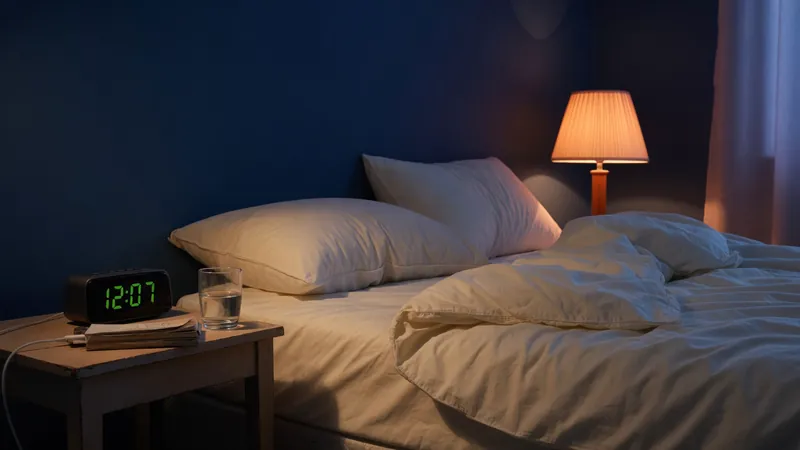
Lamps off, curtains actually closed, room cooler than feels cozy — a cool bedroom, often somewhere around the mid-60s Fahrenheit, is the common recommendation, adjusted to whatever you genuinely find comfortable. If you routinely kick the duvet off at 2am, the room is probably too warm.
Then something dull: a paper book you've read before is close to ideal — familiar, low-stakes, no notifications, and it gives your attention something to do instead of auditing your day. Don't set yourself a target. "Asleep in fifteen minutes" is a performance metric attached to something that can't be performed on demand. If you're still awake a while later, there's a separate protocol for that.
How do you build a wind-down routine that survives your worst night?
Write down the smallest version you could manage on the night you got home late, demoralized, with nothing left. For most people it comes down to three moves:
- Overhead light off.
- Warm hands and feet.
- Three lines in a notebook.
Four minutes. That's your real routine — the 60-minute version is the good-night bonus, not the standard. Set the bar at the good-night version and you'll miss it twice a week, then quietly decide the whole thing doesn't work for you. Set it at four minutes and you'll actually keep it. If you'd rather build this out as a fuller daily habit, our guide to a bedtime routine for adults walks through the anchors that matter most.
Two more things worth folding in: your caffeine cut-off matters more than the routine itself — caffeine's effects can linger for several hours in most adults, so an afternoon coffee is often still partly active at bedtime. And morning light is the other half of the story almost nobody does — ten to twenty minutes outside within an hour of waking helps set up the whole evening that follows.
Is it a problem if you miss a night?
No, and this is where people usually get it wrong in the opposite direction. The sequence matters more than the streak. Missing three nights doesn't erase progress — the cue is built through repetition over weeks, not an unbroken run.
Key takeaway
turning your wind-down into another performance target you can fail is the fastest way to make bedtime stressful, which is the exact opposite of the point.
Sleep isn't a discipline problem so much as a set of physical conditions: how bright the room is, how warm you are, and whether your head is still holding onto tomorrow.
For the fuller picture, our sleep guide has the rest.
General sleep education, not medical advice. If your sleep has been rough for more than a few weeks, or you snore, gasp, or wake up choking, please talk to a doctor. Nothing here replaces that conversation.
This article is general sleep education, not medical advice. If sleep problems persist, talk to your doctor.
Frequently asked questions
Does a warm shower really help you fall asleep?
For a lot of people, yes, and the mechanism is the opposite of what it looks like. A warm shower or bath brings blood to the surface of your skin, so you shed heat faster once you step out — and falling asleep involves a drop in core body temperature, so that cooling is the helpful part.
What's the ideal bedroom temperature for sleep?
Cooler than most people set it. A commonly cited range is somewhere around the mid-60s Fahrenheit, adjusted to what actually feels comfortable to you. A simple test: if you routinely kick the duvet off in the night, the room is probably a little too warm.
Is it bad to fall asleep with a show or podcast playing?
It's more of a trade-off than a rule. Familiar, low-stakes audio can give a busy mind something neutral to hold onto. The main issues are light from a screen and content engaging enough to keep pulling you back in, so a sleep timer and a dark screen help either way.
What if 60 minutes feels like too long to wind down every night?
Thirty minutes covers most of the same ground, and even a four-minute version — lights down, warm hands and feet, three lines in a notebook — counts as a real routine. Consistency matters far more than length.
Keep reading
 Wind-down routines
How to Build a Bedtime Routine for Adults That Sticks
How to build a bedtime routine for adults that survives a bad week — four anchors that matter more than a long nightly checklist.
Wind-down routines
How to Build a Bedtime Routine for Adults That Sticks
How to build a bedtime routine for adults that survives a bad week — four anchors that matter more than a long nightly checklist.
 Night waking
Why Do I Wake Up at 3am? (And When It's Normal)
Waking at 3am is usually normal. Here is what your body is doing, why it keeps happening at the same hour, and what to do about it.
Night waking
Why Do I Wake Up at 3am? (And When It's Normal)
Waking at 3am is usually normal. Here is what your body is doing, why it keeps happening at the same hour, and what to do about it.
 Night waking
What to Do When You Can't Fall Back Asleep: The 20-Minute Rule
The 20-minute rule for when you can't fall back asleep: why lying there backfires, and the simple boring-room protocol to try instead.
Night waking
What to Do When You Can't Fall Back Asleep: The 20-Minute Rule
The 20-minute rule for when you can't fall back asleep: why lying there backfires, and the simple boring-room protocol to try instead.